What does project management look like in automotive practice? Jiří Miler, Project Manager at Automotive Painting Partners who is based in Police nad Metují and brings nearly 30 years of experience, shares his perspective. In this interview, he explains how project launches are managed, where the greatest risks arise, and how to move from zero to series production within just a few months.
Mr. Miler, what are your responsibilities?
My role at the Automotive Painting Partners (APP) production plant in Police nad Metují is focused on the timely delivery of prototypes and samples. I manage the project up to the point of handover to series production. I ensure that we are fully prepared in terms of capacity for serial manufacturing. I am responsible for all communication with the customer – the customer does not communicate directly with production, as all coordination is handled through me. My task is to ensure that APP complies with the customer’s technical specifications, align all customer requirements, and transfer them into production in a clear and feasible manner.
How do you ensure capacity readiness for series production?
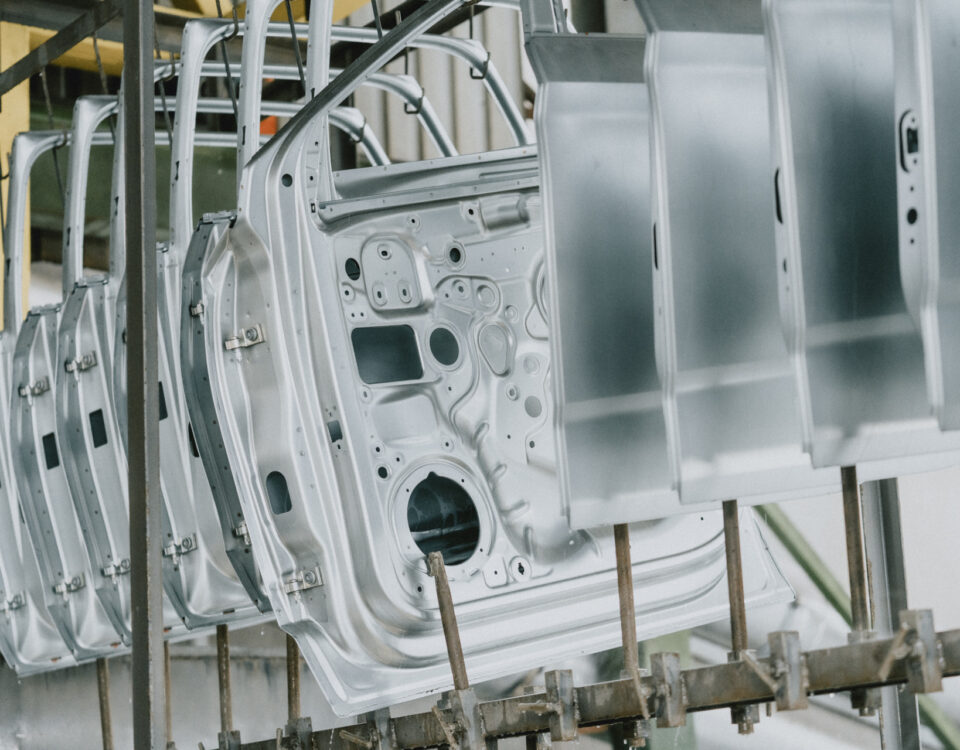
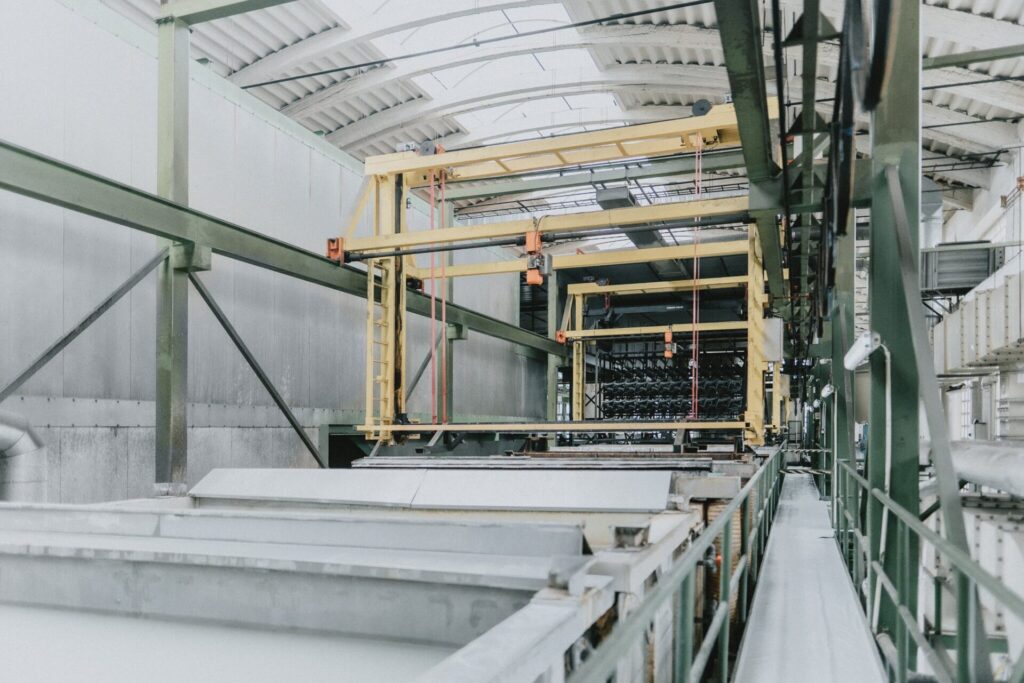
At our Police nad Metují facility, we operate one large cathodic dip coating line connected to a number of additional workstations. Everything has to be precisely timed and coordinated, as multiple projects run through the line simultaneously. Our colleagues in Nymburk operate a second coating line. Both facilities are equipped with the same state-of-the-art technology for cathodic dip coating and related downstream operations.
Overall, Automotive Painting Partners, provides comprehensive services in the field of engineering manufacturing – from project design and surface treatment to final dispatch to end customers. We cooperate with a number of leading global OEMs and Tier 1 suppliers across Europe.
What does the role of a project manager look like when you take over a project from the sales department?
A lot depends on the specific project. In the case of large and well-established automotive companies, there are clearly defined procedures for becoming a qualified supplier. The process does not begin with a simple “request–quotation” model, but involves frequent visits, audits, and an overall demonstration that we are capable of successfully managing the project.
If the customer is one we already cooperate with and have a framework agreement in place, the launch process is significantly faster. We do not need to go through the initial qualification stages, we already know each other, and communication is more efficient. In such cases, we are able to move very quickly – for example, from zero to series production within just a few weeks.
That is very fast. What enables such an accelerated project launch in practice?
A typical example is a transfer project we are currently implementing within a very short timeframe – moving from zero to series production in just two months. This is possible because we are a proven supplier and the customer has been satisfied with our cooperation over the long term. We already have contracts in place, so there is no need to repeat audits or similar qualification processes.
With new customers, the situation is different – projects are launched gradually, and the overall process takes longer. At the same time, we also manage projects that may not start for another two or three years, as they depend on release approval from the end customer. I would say that one of our greatest strengths is flexibility. If the project involves only surface treatment, the process is relatively fast. We prepare the hanging fixtures and can begin coating immediately. It becomes more complex in projects where the parts also require welding operations.
Mr. Miler, you communicate directly with Tier 1 customers. How great a responsibility is that, and where do the most common communication risks arise?
My responsibility at APP is not about managing dozens of people, but about ensuring that everything works as it should. It is my personal representation towards both the company and my colleagues. The greatest risk usually lies in the insufficient transfer of requirements from the OEM through the Tier 1 supplier. These requirements are not limited to the design of the part itself – they also affect testing, quality, processes, and logistics. If any information is lost or misinterpreted, the issue often becomes visible only during production. That is why it is essential to continuously verify information, revisit requirements, and ensure that everyone is working with the same data.
What inputs do you work with at the beginning of a project?
The foundation consists of profitability, technical specifications, standards, and project objectives. All of these factors are reflected in the feasibility study. Within this process, we primarily focus on quality requirements, productivity, and technical execution. Based on this assessment, we determine whether new tools, fixtures, or specific technological operations will be required.
PPAP sampling takes place under strict supervision. Which technical challenges do you most often address when achieving compliance for parts where aesthetic requirements meet the need for high corrosion resistance?
Technical feasibility is essential – the product must meet all quality requirements. A key role is played by the hanging fixture technology and the positioning of the part during the coating process. This has a direct impact on both surface quality and the resulting corrosion resistance. The second factor is process economics – the entire process must also make sense from a profitability perspective.
Traceability is a critical parameter in automotive manufacturing for process auditability. What system does APP use to ensure continuous monitoring of process parameters and guarantee full traceability of every step?
At APP, we ensure traceability throughout the entire process primarily through the integration of production and logistics within one continuous flow. Parts are uniquely identified and recorded throughout the process so that it is always possible to trace when, where, and how they passed through individual operations.
An important factor is also the connection between production, quality control, and dispatch. Because these processes are not separated but closely linked, we are able to trace the complete history of a part back to individual manufacturing and logistics steps. Standardised marking and systematic record management also play a major role, enabling us to respond quickly and ensure full auditability of the entire process.
How does the information flow management system between you and Tier 1 supplier partners work to eliminate data loss when transferring customer requirements into production?
Large and well-established companies usually operate supplier portals with clearly defined procedures that cannot be bypassed. We use verified access through usernames and passwords, and in some cases two-factor authentication, which means there is no need for encrypted communication through separate channels. Everything is managed in a controlled manner, and we always operate in compliance with the TISAX standard. In addition, we use standard communication methods such as e-mails and regular online meetings.
To compare, I have been working in this industry for 29 years, and today I cannot imagine how we managed in the past. Back in the 1990s, I attended meetings without a mobile phone or laptop, carrying a briefcase filled with four binders of documents. Today, that would be unimaginable.
How does APP ensure flexibility in cases where a customer suddenly changes specifications or production volumes during a project launch?
We address such situations оперативně within the team during regular meetings. We have an established quality manual, and any change of this type must be reflected in the so-called Track List, which serves as a supporting project management tool. In practice, this means returning several steps back and documenting all changes accordingly.
One of APP’s major strengths is that we are genuinely flexible and approach projects individually. We do not follow a strict “one template fits all” model, but instead adapt to the specific requirements of each customer – whether it involves changes during the project launch phase, specific technical demands, or time pressure. This enables us to respond quickly, find effective solutions, and accommodate customer needs as much as possible without compromising quality requirements or process stability.
The automotive environment requires strict compliance with IATF standards. How do you ensure compliance with these requirements?
Through predefined internal mechanisms, with project management conducted within a shared Track List. This tool covers all key steps, including deadlines, and helps us ensure that all processes are carried out in accordance with the requirements of the IATF 16949 standard.
Automotive projects often run for many years. Which tools do you use to ensure that the quality standard remains consistent even after several years of series production?
Formally, my role ends with the handover of the project to series production, where management is then taken over by the standard mechanisms of the quality management system. These are described in the so-called Document Flow, which serves as a supporting tool for quality system management and includes activities such as maintenance of production lines and hanging fixture technology, quality control, metrology, regular requalification, and similar processes.
At the same time, I do not completely disconnect from the project. In practice, customers often continue to contact me even after the transition to series production, so I remain involved in communication and handle any follow-up questions or subsequent changes. Quality assurance itself is then maintained through standard tools – in addition to the processes already mentioned, these also include audits, outgoing inspections, and other procedures that are common across the automotive industry and broadly similar among suppliers.
In your opinion, what is the main advantage of having one manager lead a project from start to finish?
A single project cannot be managed by multiple people at the same time. Everyone carries responsibility for their own projects. In manufacturing, responsibilities must be clearly defined. The Head of Technology is responsible for setting up the technological processes, while we coordinate all activities to ensure they meet customer requirements in terms of quality, volume, and deadlines.
For the customer, this primarily means reliability and having a single point of contact. They do not need to determine who to approach – communication is more direct, faster, and reduces the risk of information distortion. It also brings greater stability and confidence, because the project is overseen by one manager from beginning to end, someone who understands all related aspects and maintains continuity throughout the process. This is ultimately reflected in the final quality of deliveries.
A major advantage at APP is strong teamwork and significant support from management. Company leadership is actively involved, takes a genuine interest in projects, and helps move them forward. In practice, that is extremely important.
Thank you for the interview.